
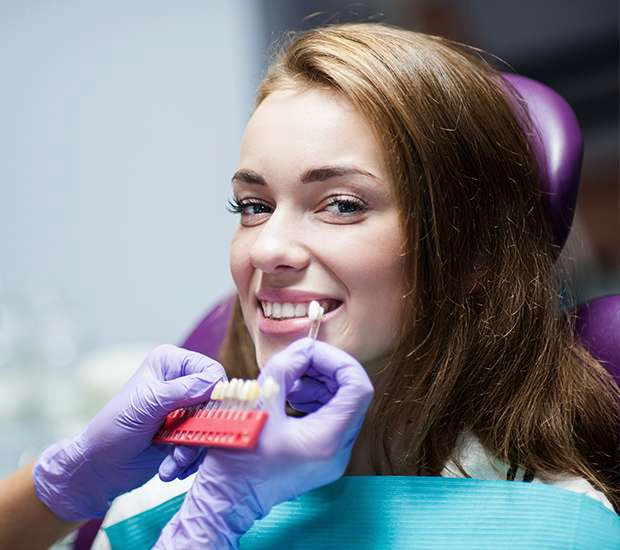
Teeth Whitening
Silverdale, WAHelp Your Smile Shine Bright
In-office whitening can brighten your smile up to 8 shades lighter. That's 6 shades lighter than store bought whitening products.
Types of Whitening
There are several types of teeth bleaching that you can try. People typically start by using whitening toothpaste at home. This can help to brighten your teeth but is typically not enough to actually whiten them. We recommend toothpaste as part of an overall teeth whitening treatment but not by itself. After professional whitening, the toothpaste can help your teeth stay bright.
Many people may try over the counter solutions like whitening trays or strips. These treatments work but not as well as professional solutions. As with most things, what you buy in the store is simply not as strong as what you can get from a medical professional. Additionally, store bought whitening trays are designed to fit everyone's teeth, not your teeth specifically. This means that they can become loose, and the solution can leak, leading to gum irritation.
We recommend that people in Silverdale, schedule an appointment with Dr. Beck and Dr. Haws instead. Our professional tooth whitening solutions can transform the appearance of your teeth in a dynamic way. This is partially due to the strength of the solution that we use. Professional grade whitening gel can whiten teeth by eight shades or more vs. around two shades with store bought solutions. If you are looking for immediate and dramatic results, in-office whitening is a far better option.
Silverdale Tooth Whitening
Dentists have coined the term "bleachorexia" for those people who overuse in-store bleaching which can lead to the destruction of enamel and dentin, turning the teeth to mush.
The process
How It Works
When a whitening solution is applied to the teeth, the hydrogen peroxide inside of the solution penetrates through the enamel. It then starts the oxidation process where molecules are transformed to reflect less or no light. This makes them appear colorless, and teeth appear white. This process is typically extremely effective for eliminating stains and can be repeated frequently.
On occasion, the stains are too strong for a teeth bleaching procedure to work. When this happens, we can provide an alternative treatment. For example, patients in Silverdale can have dental veneers placed on the surface of teeth in order to cover dark stains. This is often preferable for patients that smoke since veneers are stain resistant and won't yellow quickly like natural teeth. Still, it is wise to try a teeth whitening procedure first, before starting a cosmetic one.
At Clear Creek Dentistry, we also recommend that patients have their teeth whitened before having other dental procedures completed. Most of the materials that are used in dental restorations or for cosmetic purposes are stain resistant and bleach resistant. For example, a dental crown won't stain or bleach but should maintain its initial coloring with time. When a crown, veneer, bridge, or implant is created in a dental lab, they are created to match the shade of the surrounding teeth. If the surrounding teeth are yellow, these restorations will be created in a yellow shade. If the surrounding teeth are a brilliant white, the restoration will be as well. This makes the timing of teeth whitening procedures important. If you live in the Silverdale area and are interested in a dental restoration, schedule your teeth whitening procedure first.
Teeth Whitening FAQ
Q. Does tooth whitening cause permanent tooth sensitivity?
Q. Can I get my teeth whitened?
Q. How long does tooth whitening last?
Q. Is tooth bleaching safe?
Q. How much does tooth whitening cost?
Q. Does tooth whitening affect fillings, veneers, or crowns?
Q. Is the agent used in tooth whitening toxic?
Questions Answered on This Page
People Also Ask
Definition of Cosmetic Dentistry Terminology
- Bleachorexia
Bleachorexia is when people continue to abuse teeth whitening solutions without consulting professionals, causing significant damage to their enamel and gums in the process. - Carbamide Peroxide
Carbamide peroxide is a solution that contains hydrogen peroxide and can help to whiten teeth. - Cosmetic Dentistry
Cosmetic dentistry is generally used to refer to any dental work that improves the appearance (though not necessarily the function) of a person’s teeth, gums and/or bite. - Deeper Teeth Stains
Deeper teeth stains are stains that require professional oral health services and can result from certain foods, beverages or improper oral hygiene. - Dentin Hypersensitivity
Dentin hypersensitivity is when the enamel wears down on the tooth enough that the dentin faces exposure and will cause great levels of pain when a person applies pressure to the tooth or drinks hot/cold beverages. - Dentist
A dentist, also known as a dental surgeon, is a doctor who specializes in the diagnosis, prevention, and treatment of diseases and conditions of the oral cavity. - Hydrogen Peroxide
Hydrogen peroxide is a chemical compound in teeth whitening solutions that patients use to whiten the shade of their teeth. - Relief ACP
Relief ACP stands for amorphous calcium phosphate, which helps to relieve the pain in sensitive teeth in a gel form. - Stained Dentin
Stained dentin can result from certain foods and beverages with a lack of proper brushing. Dental professionals can provide whitening treatments to brighten the teeth. - Surface Enamel
The surface enamel is the hard outer shell that protects the dentin and pulp of the teeth. The enamel is the surface that people see when one smiles. - Surface Teeth Stains
While surface teeth stains can be inevitable with age, certain foods and beverages will only promote discoloration and faded teeth. - Teeth Whitening Concentrate
Teeth whitening concentrate is the bleaching agent that whitens the shade of teeth, which is more effective from a professional and not a general store product.
Helpful Related Links
- American Dental Association (ADA). Glossary of Dental Terms. 2015
- American Academy of Cosmetic Dentistry® (AACD). Home Page. 2015
- WebMD. WebMD’s Oral Care Guide. 2015
About our business, license, and website security
- Clear Creek Dentistry was established in 2008.
- We accept the following payment methods: American Express, Cash, Check, Discover, MasterCard, and Visa.
- We serve patients from the following counties: Kitsap County.
- We serve patients from the following cities: Silverdale, Poulsbo, Bremerton, Port Orchard, Kingston, and Bainbridge Island.
- Norton Safe Web. View Details
- Trend Micro Site Safety Center. View Details