
Why Bone Loss Happens After Tooth Loss
Understanding the causes of bone loss helps explain why grafting is so often part of implant treatment:
- Tooth extraction: Without a root to stimulate it, the bone in the empty socket begins to shrink.
- Missing teeth left unreplaced: Bone loss continues over months and years when gaps are not restored.
- Advanced gum disease: Periodontitis destroys the bone that supports the teeth.
- Long-term denture use: Traditional dentures do not stimulate the jawbone and can speed up bone resorption.
- Infection or trauma: Dental abscesses, cysts, or injuries can damage areas of the jawbone.
- Developmental conditions: Some patients naturally have thinner or narrower bone in certain areas.
Types of Dental Bone Grafts
Our dentists will recommend the type of graft that best fits your needs and the location of the bone loss:
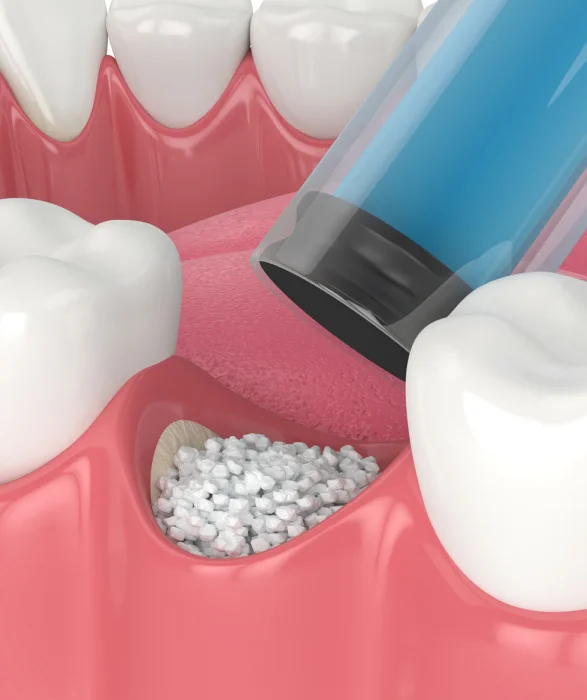
- Socket preservation: Graft material is placed immediately after a tooth is extracted to help prevent bone loss and preserve the site for a future implant.
- Ridge augmentation: Rebuilds the width or height of the jawbone ridge where bone has been lost over time.
- Sinus lift (sinus augmentation): Adds bone to the upper jaw near the back teeth, where the sinus cavity can limit bone height for implants.
- Localized bone grafting: Adds bone to a small area around an implant site to improve stability and support.
How Bone Grafting Is Performed
Bone grafting is a routine, comfortable procedure that is often completed in a single visit:
Evaluation and Imaging
We examine your mouth and take digital X-rays and scans to measure bone height, width, and density in the treatment area.
Treatment Planning
Our dentists determine the type of graft and graft material needed and explain how grafting fits into your overall implant timeline.
Numbing for Comfort
A local anesthetic fully numbs the area so you remain comfortable throughout the procedure.
Graft Placement
A small incision is made in the gum to access the bone, and the graft material is carefully placed where bone is needed. For socket preservation, the graft is placed right after the tooth is removed.
Protective Membrane and Closure
A protective membrane may be placed over the graft to support healing, and the gum is closed with stitches.
Healing and Monitoring
Over the next three to six months, new bone grows and integrates with the graft. We monitor your progress and schedule your implant placement once the area is ready.
Who May Need a Bone Graft?
You may benefit from bone grafting if you:
- Are planning to get dental implants but have been told you do not have enough bone
- Are having a tooth extracted and want to preserve the site for a future implant
- Have been missing teeth for an extended period
- Have experienced bone loss from gum disease or infection
- Have worn dentures for many years and want to switch to implants
- Need implants in the upper back jaw where the sinus limits bone height
During your implant consultation, our dentists will use digital imaging to measure your bone and determine whether grafting is needed.
Benefits of Bone Grafting
Bone grafting offers important advantages for your oral health and your future smile:
- Makes implants possible: Rebuilding bone creates a solid foundation for secure, long-lasting dental implants.
- Improves implant success: Adequate bone volume helps implants integrate properly and remain stable.
- Preserves facial structure: Restoring bone helps prevent the sunken appearance that can follow tooth loss.
- Supports natural-looking results: Proper bone and gum contours help implant restorations look more natural.
- Protects neighboring teeth: Maintaining bone around extraction sites supports the stability of nearby teeth.
- Prevents further bone loss: Socket preservation helps stop bone shrinkage before it starts.
Insurance and Financing for Bone Grafting
Some dental insurance plans provide partial coverage for bone grafting, particularly socket preservation after an extraction or grafting needed for implant placement. We accept a variety of insurance plans, and our team will review your benefits and provide a clear cost estimate. We also offer CareCredit financing to help make your implant preparation more manageable.
Build a Strong Foundation for Your Smile
Bone loss does not have to stand between you and dental implants. With bone grafting at Clear Creek Dentistry, you can rebuild a healthy foundation and move forward with a permanent, natural-looking smile. Call us or request an appointment online to schedule your implant and bone grafting consultation.
Schedule a Bone Grafting ConsultationFrequently Asked Questions About Bone Grafting
A dental bone graft is a procedure that adds bone or bone-like material to the jaw to rebuild areas where bone has been lost. It creates a strong foundation for dental implants and helps preserve facial structure.
Clear Creek Dentistry provides bone grafting as part of our in-house implant care at our office at 2430 NW Myhre Rd #201 Silverdale, WA 98383 in Silverdale, WA, so your grafting, implant placement, and restoration all happen with one team.
Not everyone needs a bone graft. It is recommended when there is not enough bone height or width to securely support an implant. Our dentists will measure your bone with digital imaging to determine whether grafting is needed.
Bone grafting is performed with local anesthetic, so you should feel little to no discomfort during the procedure. Mild soreness and swelling afterward are normal and usually improve within a few days.
Most bone grafts take three to six months to heal and integrate before an implant can be placed. Smaller grafts placed at the same time as an implant heal alongside the implant.
Socket preservation is a type of bone graft placed immediately after a tooth extraction. It helps prevent the bone from shrinking and preserves the site for a future dental implant.
Yes. Dental bone graft materials are sterilized, biocompatible, and widely used. Over time, your body replaces the graft material with your own natural bone.
Some dental insurance plans cover a portion of bone grafting, especially when it is needed after an extraction or for implant placement. We accept a variety of insurance plans and offer CareCredit financing for any remaining costs.