Advantages of Protective Tooth Sealants
Sealants are a small investment of time with a big payoff for long-term oral health:
- Proven cavity prevention: Sealants block bacteria and food debris from settling into the grooves where decay is most likely to start.
- Quick and painless: Each tooth takes only a few minutes to seal, with no shots, drills, or discomfort.
- Tooth-preserving care: Sealants protect healthy enamel without removing any tooth structure.
- Invisible protection: Clear or tooth-colored sealant material blends in naturally, so no one will know it is there.
- Long-lasting results: With good care, sealants can protect teeth for several years and can be touched up easily at routine checkups.
- Savings over time: Preventing a cavity costs far less than treating one with a filling, crown, or root canal later.
Is Your Child Ready for Dental Sealants?
Sealants work best when placed soon after permanent molars come in, before decay has a chance to develop. The ideal windows are usually:
- Around age 6: When the first permanent molars erupt
- Around age 12: When the second permanent molars erupt
- Teen years: For premolars and molars with deep grooves
Sealants are not just for kids. Our dentists may also recommend them for:
- Adults with deep pits and fissures but no fillings or decay on those teeth
- Patients with a history of frequent cavities
- People with dry mouth caused by medications or health conditions
- Patients wearing braces, who may find it harder to clean their back teeth
- Baby molars with especially deep grooves in children at higher risk for decay
During your family’s routine checkup, our team will evaluate each tooth and let you know whether sealants are a good fit.
How We Apply Dental Sealants, Step by Step
Getting sealants is one of the easiest appointments your child will ever have. Most patients can have several teeth sealed in a single short visit, often right after a cleaning. Here is what happens:
Consultation and Assessment
We discuss your goals and symptoms, review your medical history, and evaluate your facial muscles, jaw, and smile.
Personalized Treatment Plan
Our team determines the precise injection sites and the right amount of Botox® to achieve your desired results.
Skin preparation
The treatment area is cleaned, and a cold compress or topical numbing may be used for added comfort.
Precise Injections
Using a very fine needle, we place small amounts of Botox® into the targeted muscles. The process usually takes just a few minutes.
Aftercare Guidance
We review simple instructions to help you get the best results and avoid moving the product away from the treatment area.
Follow—up Visit
We check your results about two weeks later and make any small touch-ups if needed.
Why Back Teeth Are More Likely to Get Cavities
Molars do the heavy lifting when it comes to chewing, and their shape makes them especially vulnerable. Deep grooves trap food, they are harder to see and reach with a toothbrush, and children often miss them while still learning to brush on their own. Permanent molars also erupt behind the baby teeth, so parents may not realize they have come in. Sealing these teeth early protects them during the years when cavity risk is highest.
Caring for Teeth with Sealants
Sealants are durable, but a few simple habits help them last as long as possible:
- Keep brushing twice a day with fluoride toothpaste and flossing daily, since sealants protect only the chewing surfaces.
- Avoid chewing ice, hard candy, and other very hard objects that can chip the sealant.
- Keep up with six-month checkups so our team can inspect sealants and repair any worn areas.
- Let us know if a sealed tooth ever feels rough or different when you bite down.
Give Your Child’s Smile Extra Protection
A few minutes in the dental chair today can help your child avoid cavities for years. Our team at Clear Creek Dentistry makes sealant appointments fast, gentle, and stress-free for kids and parents alike. Call us or request an appointment online to ask about dental sealants at your family’s next visit.
Schedule a Sealant VisitFrequently Asked Questions About Dental Sealants
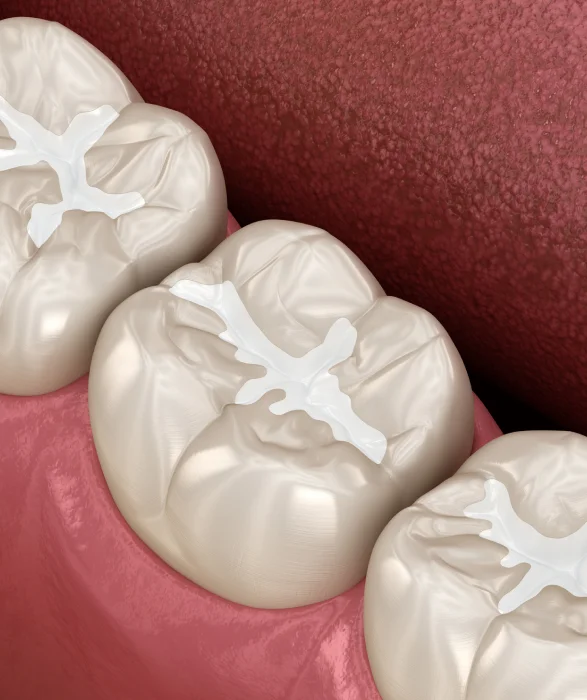
Dental sealants are thin, protective coatings painted onto the chewing surfaces of back teeth. They fill in the deep grooves where food and bacteria collect, creating a smooth barrier that helps prevent cavities.
Most children receive sealants on their first permanent molars around age 6 and on their second permanent molars around age 12. Sealing teeth soon after they erupt offers the best protection.
Dental sealants typically last several years and can protect teeth for up to a decade with good care. Our team checks sealants at every routine visit and can reapply or repair them if they show wear.
No. Getting sealants is completely painless. There is no drilling, no needles, and no numbing required, which makes the experience easy for young children.
Yes. Dental sealants have been used safely for decades and are recommended by the American Dental Association and the CDC. The amount of material used is very small, and sealants are considered a safe, effective way to prevent tooth decay.
Yes. Adults who have deep grooves in their back teeth and no fillings or decay on those surfaces can benefit from sealants, especially if they are prone to cavities or have dry mouth.
Many dental insurance plans cover sealants for children and teens on permanent molars, often up to a certain age. We accept a variety of insurance plans, and our team can check your coverage before treatment.
Yes. Sealants harden completely under the curing light during your appointment, so your child can eat and drink normally as soon as the visit is over.